Updates and improvements to our Targeted Loci Database
Metagenomic studies are often powered by one of two technologies: whole genome sequencing (WGS), an “untargeted” approach that sequences and analyzes the entire DNA content of a sample; or amplicon sequencing, which targets specific marker genes (often 16S rRNA in bacteria/archaea and ITS rRNA in fungi). Although WGS is a popular choice due to its high resolution and reduced bias [1], 16S and other types of amplicon sequencing remain cost-effective strategies for microbial community surveys at scale. Moreover, the development and adoption of long read sequencing technologies, such as Oxford Nanopore and PacBio, have been a boon for 16S sequencing and analysis. These technologies enable recovery of complete, full-length marker genes and can provide better species-level resolution of microbial samples [2].
Here at One Codex, we support and maintain a variety of tools to help empower your metagenomic
research. One of these tools is our Targeted Loci Database–a curated collection of 16S, 23S,
ITS, and other marker gene sequences spanning bacterial, archaeal, and fungal species.
Today, we’re proud to announce one of our largest updates to the Targeted Loci Database,
including newly curated marker sequences, new organisms, and the latest revision of the NCBI taxonomy.
Over 275,000 sequences, spanning more than 15,000 organisms
We introduced the Targeted Loci Database in 2017 with ~250,000 gene sequences and it’s become the foundation for fast, reproducible amplicon analysis on the One Codex platform. Today’s update adds over 19,000 new sequences (Fig. 1). These new sequence records consist of full-length genes across more than 15,000 bacteria, archaea, and fungi. Over 13,000 of these organisms are new to the database. We’ve also enriched the sequence content of more than 2,000 existing organisms (Fig. 2) to provide you with the most comprehensive database for microbial identification.
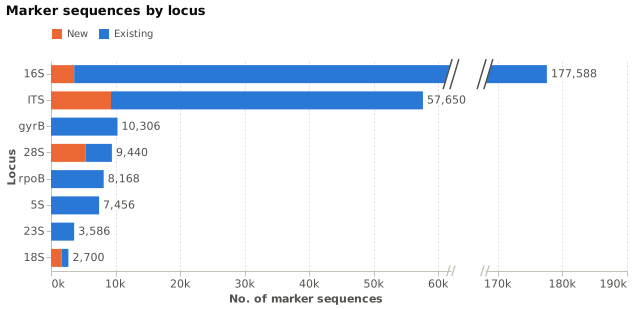
Figure 1. Marker sequence content in the Targeted Loci Database grouped by locus. Newly added sequences are depicted in orange (New) and pre-existing sequences are depicted in blue (Existing).
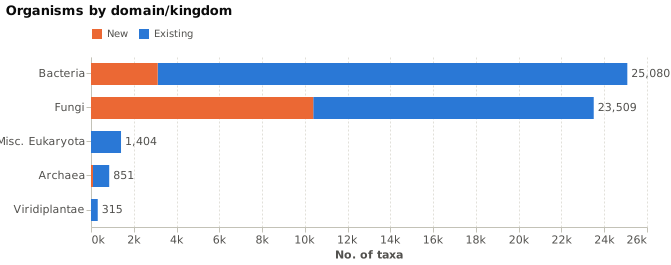
Figure 2. Supported organisms in the Targeted Loci Database grouped by domain or kingdom. The Targeted Loci Database supports thousands of bacterial, archaeal, and fungal species. It also supports a variety of eukaryotes (e.g., protists) and algal species (Viridiplantae). Newly added organism counts are depicted in orange (New) and pre-existing organism counts are depicted in blue (Existing).
Improved species-level resolution of metagenomic samples
Two often cited assumptions regarding the use of 16S (and other amplicon sequencing) data for taxonomic identification are species-genus level boundaries and the resolution at which organisms can be identified. With respect to the former, these boundaries are usually defined using sequence identity–two sequences represent the same species if their average nucleotide identity (ANI) is >= 97%, and belong to the same genus if their ANI is >= 95% [3]. This boundary has considerable implications when using 16S data for identification; it is often the case that commonly targeted 16S subregions are only able to provide genus-level information or higher [4].
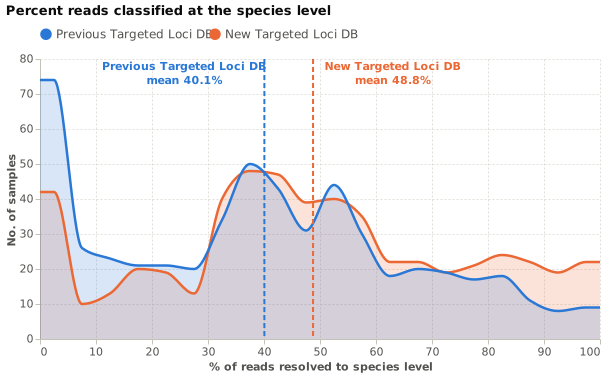
Figure 3. Percentage of reads in a sample that are classified at the species level (Targeted Loci 2025 vs. Targeted Loci 2026). Each curve represents the percentage of reads classified at species-level resolution for a set amount of samples. The 2026 version of the Targeted Loci Database improves species-level resolution of reads on a subset of ~500 benchmark samples.
At One Codex we’ve curated and optimized our Targeted Loci Database to maximize species-level detection where possible. Our newest update exhibits not only an increase in the total amount of content classified per sample but also far greater species-level resolution of sequencing reads (Fig. 3), guaranteeing you the most accurate microbial identification possible.
This new update is live and freely available for all One Codex users. Our platform automatically detects amplicon sequencing data independent of library prep or protocols and will automatically run the Targeted Loci analysis for these samples. However, if you’d like to run it yourself, you’ll find the analysis available on the Run Workflows page. If you’re interested in our curation process (including selection, data hygiene, etc.) or other technical details, check out our documentation page. Finally, if you’d like to see your favorite species added to our references, or you have any questions, please let us know.
References
- Durazzi, F. et al. Comparison between 16S rRNA and shotgun sequencing data for the taxonomic characterization of the gut microbiota. Sci Rep 11, 3030 (2021).
- Aja-Macaya, P. et al. Nanopore full length 16S rRNA gene sequencing increases species resolution in bacterial biomarker discovery. Sci Rep 15, 26486 (2025).
- Schloss, P. D. & Handelsman, J. Introducing DOTUR, a Computer Program for Defining Operational Taxonomic Units and Estimating Species Richness. Applied and Environmental Microbiology 71, 1501–1506 (2005).
- Johnson, J. S. et al. Evaluation of 16S rRNA gene sequencing for species and strain-level microbiome analysis. Nat Commun 10, 5029 (2019).